Service · Markings & compliance

Line painting &
ADA-compliant markings.

Stripes, arrows, stencils, EV stalls, fire-lane markings, and ADA accessibility striping — installed with materials that meet code on day one and on year five.

What it is

Curb appeal and the federal codebook.

The day a lot gets restriped is the day customers notice it's been maintained. But line painting is also where pavement work intersects most directly with the law — the ADA-compliance specs that govern accessible parking, the EV-charging stencil requirements that vary by jurisdiction, the fire-lane standards that fire marshals walk lots specifically to check.

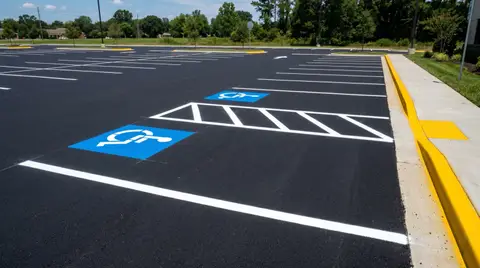
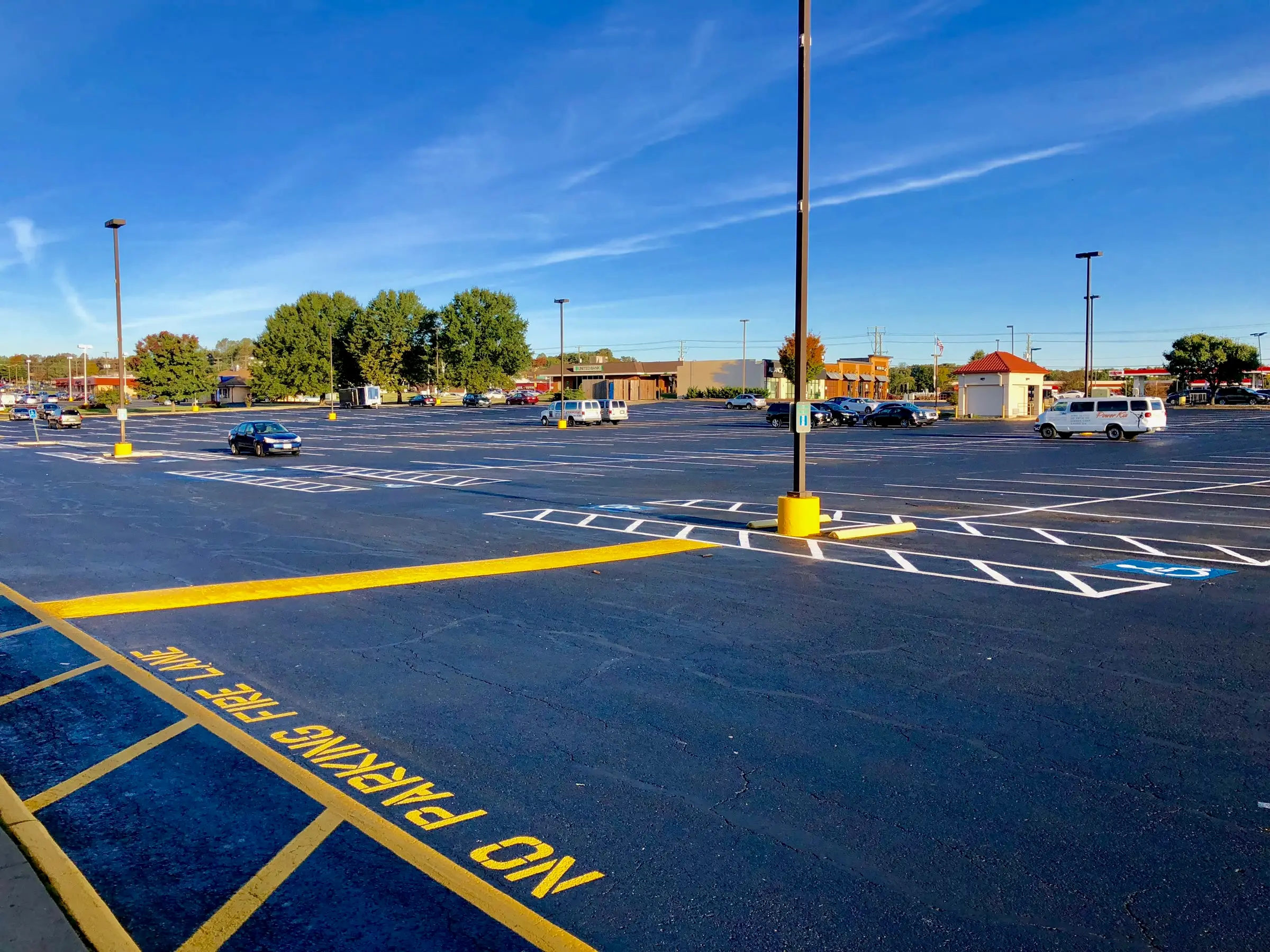
We do all of it. Standard parking-stall striping with fresh contrast lines. Directional arrows and stop bars. Numbered stalls, reserved-stall stencils, ADA accessible-stall striping with the international symbol of access (ISA), van-accessible stall layouts, EV-charging stencils, bike-lane markings, crosswalks, and stop-line markings at exits.

For materials, we run two tracks. Traffic paint — water-based latex or solvent-based — is the cost-effective choice for annual or biannual restripe cycles. Pre-loaded with retroreflective glass beads for night visibility, it hits the spec on day one. Where longevity matters more than cost — heavy-traffic lots, distribution centers, airport ground markings — we switch to thermoplastic, a hot-applied resin that bonds chemically to the asphalt and holds its retroreflectivity for 5-7 years versus 1-3 on paint.

When to use it

Every restripe is also a compliance window.

  • Pre-tenant turnover or pre-lease restripe
  • Annual maintenance refresh for retail and HOA properties
  • Post-rejuvenation or post-overlay (always restripe after either)
  • ADA compliance audit response — DOJ complaint or pre-emptive
  • EV-charging rollouts requiring stall sizing under Title 24 or local codes
  • Fire-marshal inspection prep: fire lanes, hydrant clearances, NFPA 1 compliance
  • Industrial and distribution yards with new traffic-flow patterns
  • Lane-line and shoulder striping specced to MUTCD requirements
The process

From site survey to same-day re-open.

  1. 01

    Site survey & compliance check.

    We walk the lot with a digital smart level, measuring cross-slopes at every accessible stall and access aisle. We catalog existing stalls against current ADAAG specs and flag any that fail. Output: a stall-by-stall report.

  2. 02

    Layout & marking.

    Stall locations get chalk-snapped or laser-projected for accuracy. ADA stalls get sized to ISA-compliant dimensions and located on the shortest accessible route from a building entrance.

  3. 03

    Surface prep.

    Existing paint gets shot-blasted or ground off where re-layout shifts a stall. Loose debris swept away. The surface needs to be dry and above 50°F for paint, 55°F for thermoplastic.

  4. 04

    Primary stripe application.

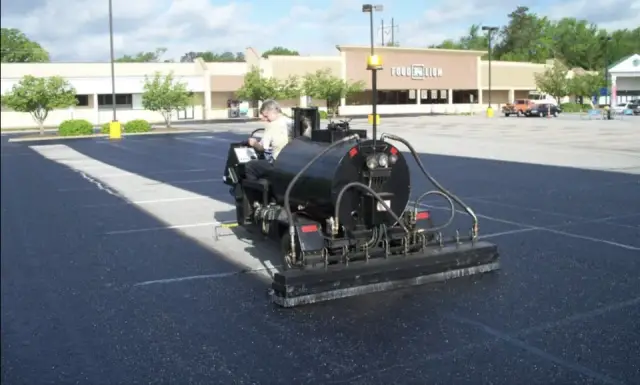
    Traffic paint sprayed at calibrated mil-thickness with pre-loaded retroreflective glass beads. Or thermoplastic preheated to 425°F and screed-applied with a glass-bead drop on top for night visibility.

  5. 05

    Stencils, arrows, ADA markings.

    Hand-rolled or sprayed through laser-cut stencils for symbols, numbers, directional arrows, and ADA accessibility icons. ADA-compliant blue per the federal color spec.

  6. 06

    Cure & re-open.

    Traffic paint cures in 30-90 minutes depending on temperature and humidity. Thermoplastic cures in 10-15 minutes — it solidifies on cooling. Lot back in service same day for most configurations.

By the numbers

Compliance specs.
Quick read.

The numbers that govern ADA accessibility, EV stall sizing, and the material choice between traffic paint and thermoplastic. Full spec references available on request.

  • ≤1:48

    ADA cross-slope

    Every direction, ramps + aisles

  • 5–7 yr

    Thermoplastic life

    Traffic paint: 1–3 yr

  • 250+ mcd

    Retroreflectivity

    MUTCD spec: 150 mcd minimum

  • 110"

    Van-accessible stall

    Car-accessible: 96" minimum

Accessibility compliance

ADA parking lot striping requirements, measured stall by stall.

Accessible-stall rules are not "8'×18' with a hashed aisle." They depend on whether the stall is van-accessible (110" minimum width vs. 96" for car-accessible), the cross-slope of the running surface (≤1:48 in every direction), the access-aisle width (60" for car, 96" for van), placement on the shortest accessible route to a building entrance, and the ratio of accessible-to-standard stalls on the lot. We field-measure every stall against current ADAAG and 2010 ADA Standards. If your lot was striped to old specs, we tell you which stalls need to move and which can stay.

Total stalls on the lot Accessible stalls required
1 – 25 1
26 – 50 2
51 – 75 3
76 – 100 4
101 – 150 5
151 – 200 6

Larger lots continue up the federal table from there, and one of every six accessible stalls — or fraction of six — must be van-accessible. The counts are federal: the 2010 ADA Standards apply to Virginia, Maryland, and DC lots alike, but enforcement arrives locally, through building officials and private lawsuits. Every restripe is a compliance window — fixing a failing stall while the crew is already striping costs a fraction of a remediation order later.

What it costs

Parking lot striping cost, per linear foot and per stall.

It's the cheapest pavement work you'll do — small absolute dollars with an outsized return on perception and compliance. Lines are quoted per linear foot, stencils and symbols per unit, and compliance work per stall. Treat the figures below as ranges, not quotes.

Approach Typical cost Service life Right for
Traffic paint (full restripe) $0.15 – $0.30 / linear ft 1–3 years Annual maintenance cycle
Thermoplastic (full restripe) $0.55 – $0.95 / linear ft 5–7 years Heavy-traffic or DOT spec
Per-stall (ADA add or relocate) $35 – $75 / stall Same as base material Targeted compliance fix
ADA compliance audit only $200 – $500 flat Point-in-time report One-time deliverable

The compliance numbers matter even if you don't care about appearance. ADA Title III violations carry first-time federal penalties up to $75,000 and per-stall remediation orders. Most enforcement actions are private rights-of-action — a customer files, the property owner pays for both remediation and legal fees. A $400 audit and a $35-per-stall relocation is the cheap defense.

Real pricing depends on stall count, layout complexity, and material choice. The figures above are an order-of-magnitude comparison, not a quote.

Frequently asked

Seven questions we hear on every audit.

What is parking lot striping?
The layout and application of every painted marking a lot needs — parking stalls, directional arrows, stop bars, crosswalks, fire lanes, EV-charging stencils, and ADA accessible-stall markings — in traffic paint or hot-applied thermoplastic. Striping is priced mostly per linear foot, with stencils and symbols priced per unit, and on most commercial lots it's the least expensive line item in the pavement maintenance budget.
How do I know if my accessible stalls are compliant?
We measure cross-slope at every accessible stall and aisle using a digital smart level, then check stall widths, aisle widths, ISA marking placement, signage height, and accessible-route slope back to the entrance. The single most common failure: a cross-slope greater than 1:48 (about 2%) in the access aisle. Often the fix is just a relocate to a flatter part of the lot.
EV-charging stalls — what are the sizing rules?
They vary by jurisdiction, but California Title 24 — which most state codes track — requires a 9'×18' stall plus an accessible access aisle on at least one EV stall per location. The ISA marking is required if that stall is also accessible. New-construction permits typically require 5-10% of total stalls to be EV-capable. We lay out to current local code on the date of installation.
Paint vs. thermoplastic — when is each right?
Traffic paint for annual cycles, lower-traffic lots, smaller absolute budget. Thermoplastic for heavy-traffic lots, high-visibility priority (state roads, healthcare entrances, industrial yards), or 5-7-year maintenance windows. Total cost of ownership over a six-year window is usually slightly favorable to thermoplastic because of fewer application cycles.
Should I restripe annually or every three years?
Depends on the material and the lot. Traffic-paint lots in heavy-use commercial settings benefit from annual touch-up of high-wear stalls (drive-through approaches, entrance lanes) plus a full restripe every two to three years. Thermoplastic lots can typically run five to six years between full restripes. We can plan the cycle around your maintenance calendar.
What's the warranty?
Every application is backed by a written warranty — the exact term depends on the service, and it's spelled out in the proposal before you sign. Material service life is a technical expectation rather than a guarantee — wear depends on traffic volume, sweep schedules, and de-icing chemical exposure. ADA-compliance work is delivered against the spec in effect on the install date, in writing.
Can you stripe in winter?
Generally no for paint — curing requires surface temperature above 50°F and no rain for six-plus hours. Thermoplastic has wider weather tolerance because it cures on cooling, but installation still requires a clean, dry, above-freezing surface. Most of our striping in the mid-Atlantic happens between April and October.
Free ADA pre-audit

Compliant on the install date.
Still compliant in year five.

A free site walk with a smart level, a stall-by-stall compliance report, and a recommendation — touch-up, full restripe, or per-stall relocates.

Get in touch

Let's talk about your pavement.

Tell us a few quick things. We respond within 48 hours · no obligation.

Need to share photos or qualify a complex project? Use the full project form →

Our free webinar is coming soon →

By submitting, you agree to our Terms of Use and acknowledge the Privacy Policy.