





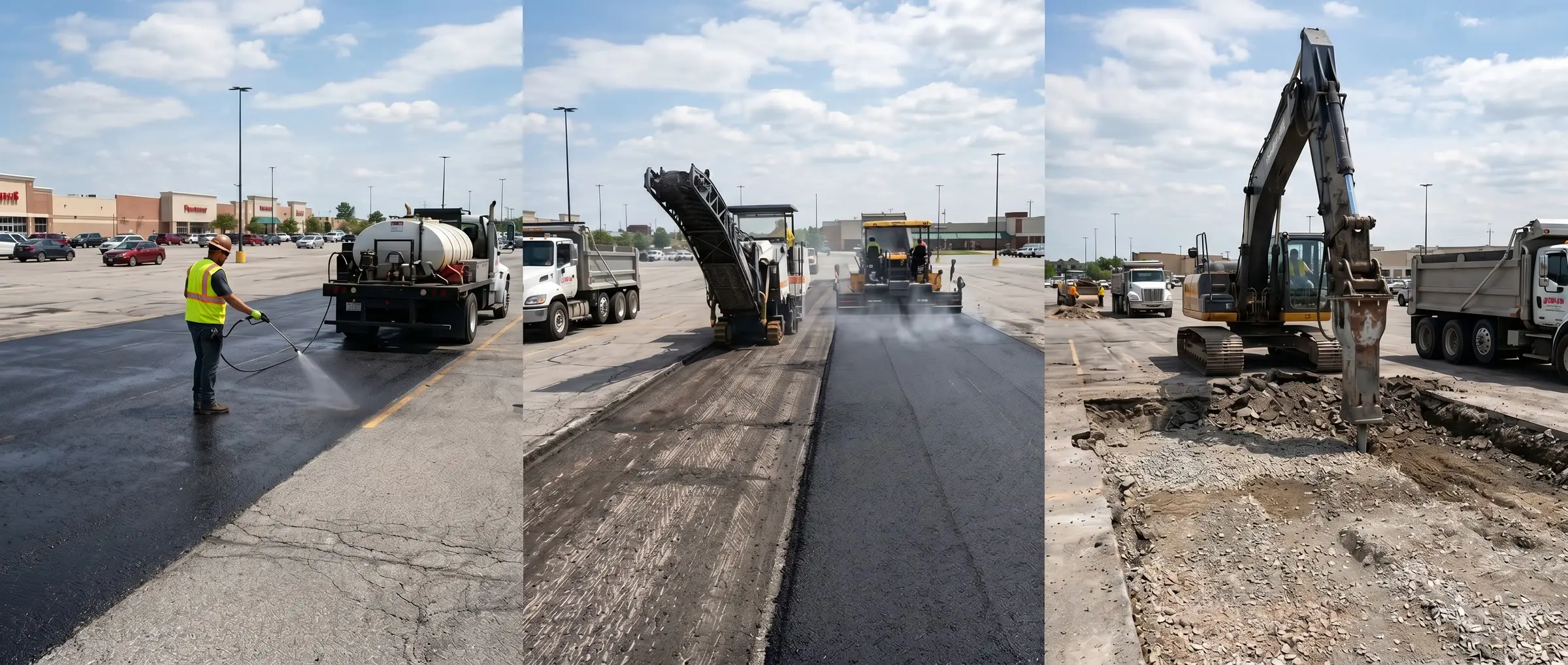
Pavement lifecycle cost analysis: rejuvenation vs. mill-and-overlay vs. full reconstruction
A 20-year, cost-per-square-yard breakdown of the three pavement paths most facility managers face — and why the cheapest option on day one is rarely the cheapest one by year ten.
If you manage a commercial pavement portfolio for long enough, you eventually have the same argument three different ways. The CFO wants the cheapest option this fiscal year. The facilities lead wants the option that won’t blow up on her watch. The sustainability officer wants whichever number minimizes embodied carbon. None of them are wrong — and the right answer almost always changes once you stop comparing initial cost and start comparing 20-year cost-per-square-yard, including downtime, deferred capital, and re-treatment cycles.
This piece is a working document for that conversation. The numbers below are realistic planning ranges for commercial pavement work; they will move with regional labor, oil prices, and the spec of any individual lot. Use them as a starting frame, then sit down with a contractor willing to put your specific site on paper.
The three paths, defined
There are really only three paths most owners face on an aging asphalt lot. They sound similar in the proposal but they are not the same intervention.
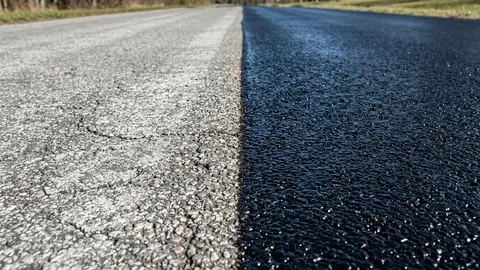
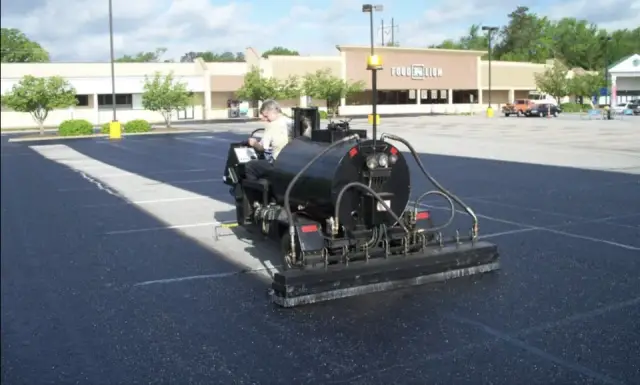
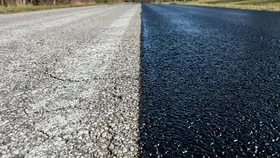
Rejuvenation is a chemistry play. A bio-based or petroleum-based penetrating rejuvenator is applied to the wearing surface, soaks from three-eighths of an inch to a half inch into the asphalt, and restores the binder’s flexibility — the property that gets used up first as asphalt oxidizes. Done correctly on a sound base, it adds four years of structural life per application, with no tear-out, no shutdown, and a same-day return to service. It is not sealcoating, which sits on top of the asphalt and is a UV shield, not a chemistry restorer.
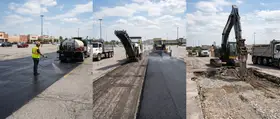
Mill-and-overlay is a removal-and-replacement play, but a partial one. The top 1.5”–2” of asphalt is milled off and trucked away; a new lift is placed over the existing base. It’s the right call when the wearing course is genuinely spent but the base, sub-base, and drainage are still good. New asphalt typically delivers 10–15 years of service before the next intervention, depending on traffic and climate.
Full reconstruction is a structural play. The full depth of asphalt is removed, the base course is rebuilt or replaced, and a new pavement section is constructed from the sub-grade up. It’s the right call when the base has failed — alligator cracking through the full depth, deep rutting, drainage that’s actively breaking the section apart — and rejuvenation or overlay would be pouring money on top of a failing structure. Service life is typically 15 years or more on a properly designed section.
A side-by-side at 60,000 square yards
The table below assumes a representative 60,000-square-yard commercial lot — roughly a regional shopping center, a mid-size distribution yard, or an HOA’s main road network. Numbers are in 2026 dollars and reflect installed cost, not just material. Re-treatment cadence is the average we plan around; your lot may run faster or slower.
| Path | Year-0 installed cost | Service life | Re-treatment over 20 years | 20-year total (rough) | Effective $/sy/yr |
|---|---|---|---|---|---|
| Rejuvenation cycle (plant-based) | $90,000–$150,000 | 4 yrs per application | 5 applications + minor crack sealing | $450,000–$790,000 | $0.38–$0.66 |
| Mill-and-overlay (2” lift) | $1,215,000–$1,800,000 | 10–15 yrs | 2 overlays (yr 0 and yr 10–15) | $2,430,000–$3,600,000 | $2.03–$3.00 |
| Full reconstruction | $4,500,000–$6,600,000 | 15+ yrs | One rebuild — priced here as a single event; heavy traffic or a failing sub-base can force an earlier second, which these figures don’t carry | $4,500,000–$6,600,000 | $3.75–$5.50 |
A few things worth noting before you take these numbers to your board:
- How the last column is figured, and where it’s conservative. Every path is costed across the same fixed 20-year window, and nothing is credited back for service life still left in the ground when the window closes. That cuts against the capital options: an overlay placed in year 15 has most of its life ahead of it at year 20 but is charged in full, and a reconstruction that runs past 20 years is charged once against a period shorter than it serves. Read the column as cost over a fixed planning horizon, not as any one treatment’s cost per year of its own life. On the latter basis the ranges widen at both ends and the gap between the paths narrows.
- These figures assume the right path for the lot. A rejuvenation cycle costed against a lot that actually needs reconstruction is a fantasy budget — the chemistry can’t save a failing base, and you’ll be writing the bigger check anyway, two years late and with a liability claim attached.
- Downtime is not in the line items. A mill-and-overlay on a working shopping center is typically 4–8 weeks of phased disruption to deliveries and tenant access. A full reconstruction is 8–16 weeks. A full rejuvenation pass is overnight; the lot is back in service before the first stores open. For an owner whose tenants pay percentage rent or whose distribution lanes can’t close, that downtime delta is often larger than the installed-cost delta.
- These are commercial-grade numbers. Municipal DOT lanes and aviation surfaces have spec premiums on top of these ranges.
Where the “cheap option” stops being cheap
The trap most owners walk into is comparing the year-0 invoice, not the 20-year position. Rejuvenation has the smallest invoice on day one — which is exactly why it’s the most attractive option, and also why it gets dismissed as “just a coating” by anyone who’s been burned by a cheap sealcoat. Both reactions are wrong.
Rejuvenation isn’t cheap because it’s a shortcut. It’s cheap because it works on the layer of the pavement that’s actually aging in the first decade of life. Asphalt fails from the top down, in a slow oxidation reaction that uses up the binder’s light, oily fractions. If you intervene with a rejuvenator before the binder is depleted, you reset the clock on that reaction without disturbing the base, the sub-grade, or the drainage. There’s no aggregate to mine, no new binder to refine, no asphalt to truck in. The structural section you already paid for stays in place; you just keep its surface flexible enough to absorb traffic loads instead of crack under them.
The same logic flips on a lot whose base has actually failed. Rejuvenating a failing base buys you nothing — the chemistry can’t pretend a structural problem doesn’t exist, and any contractor selling that to you is misreading the lot or hoping you won’t notice for two years.
“The right question isn’t ‘rejuvenation or repave.’ The right question is, ‘where on this lot is which one the honest answer?’ On almost every job we walk, the answer is mixed — rejuvenate the field, reconstruct the two or three sub-areas that have actually failed, put the whole thing on a four-year cycle. That’s the strategy that survives a 20-year cost-per-square-yard comparison.”
— Jeff Pokorny, Founder
A second-order cost almost nobody books
There’s a line item that doesn’t appear on any of the proposals an owner gets and is often the largest variable in this whole calculation: the carrying cost of capital deferred to the next cycle.
A mill-and-overlay at year 8 instead of year 0 isn’t free — but it is, in net-present-value terms, dramatically cheaper than a mill-and-overlay at year 0. The same dollars deployed eight years later, against a property whose value has presumably grown, against a budget whose absolute size has presumably grown, is a materially smaller relative draw. A rejuvenation cycle that pushes the big capital number out by 8–12 years isn’t just buying you pavement life; it’s buying you capital optionality. For an owner running a portfolio, that’s the line their CFO will care about long after the per-square-yard table is forgotten.
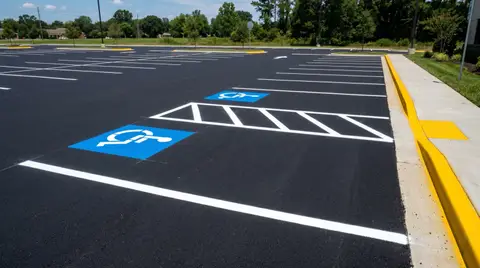
There’s also a smaller, more boring carrying cost that nobody talks about: the cost of an ugly lot. A 20-year-old shopping center with gray, raveling asphalt and faded ADA striping reads as a neglected center to every shopper, every prospective tenant, and every appraiser walking it. A lot fresh off a Revolution BLACK™ pass reads true black, with crisp thermoplastic. That visual reset is real money on rent-roll, on tenant retention, and on disposition value. It rarely shows up on the pavement spreadsheet, but it absolutely shows up on the operating P&L.
When each option is the right one
The honest version, after three-plus decades of doing this work, looks something like this.
Rejuvenate when the wearing course is oxidized but intact — gray, dry-looking, surface ravel, hairline cracking — and the base is sound. Most commercial lots between years 4 and 12 of their life are in this category. A rejuvenation cycle keeps them in that category toward the 25-plus years of service the maintenance math is built on.
Overlay when the wearing course is genuinely spent — moderate cracking, isolated patches, surface that no longer holds binder — but the base hasn’t broken up underneath. This is typically year 12–18 in the life of an unmaintained lot, or what’s left after a couple of rejuvenation cycles on a high-traffic site that wears its surface faster than the chemistry can keep up.
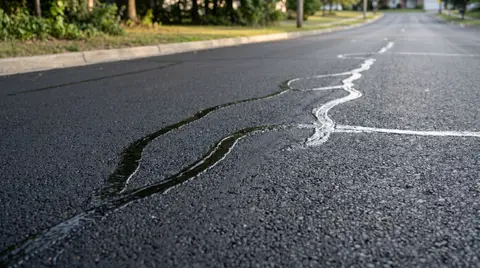
Reconstruct when the base has failed. Alligator cracking through full depth. Deep rutting. Bird-bath drainage. Sub-grade pumping. If you can see any of those, no rejuvenation cycle will save you, and an overlay placed over a failed base will reflect every problem in the section back through to the new surface within 18 months.
And on almost every real lot we walk, the answer isn’t one of those three — it’s some mix. Rejuvenate 80% of the field, reconstruct the loading apron, seal the joints, restripe the whole thing in one overnight pass. The cost-per-square-yard line item on that mix is the smallest you can defensibly produce for the lot, and it pushes the next big capital number out the furthest. That’s the math.
What to ask the contractor
Three questions, in this order.
- “Walk me through which sub-areas of this lot are candidates for which path, in writing.” A contractor who answers with one number for the whole lot is not planning your asset’s lifecycle. They’re quoting a transaction.
- “What’s the 20-year cost-of-ownership comparison for the mix you’re proposing versus a straight overlay?” This is the number that matters. If they can’t produce it, find a contractor who can.
- “What does the re-treatment cycle look like, and what’s your written commitment on revisits?” Rejuvenation is a cycle, not a one-time service. The contractor’s plan should include scheduled re-treatments, joint sealing, and striping refresh on a cadence. If it doesn’t, you’re buying a one-shot and calling it a strategy.
The right answer to all three is the one your CFO, your facilities lead, and your sustainability officer can sign off on at the same meeting. That’s the bar.
Short answers to the follow-up questions.
- How is rejuvenation different from sealcoating?
- Sealcoating is a thin coating that sits on top of asphalt and shields the surface from UV and water for a few years; it doesn't penetrate or change the chemistry of the binder underneath. Rejuvenation — done correctly with a penetrating rejuvenator like Revolution BLACK™ or Delta Mist® — soaks from three-eighths of an inch to a half inch into the wearing course and restores the asphalt binder's flexibility. Sealcoat cosmetically resets the lot. Rejuvenation buys years of structural life. Both have their place, but they aren't interchangeable.
- Doesn't a mill-and-overlay last longer than rejuvenation?
- A new lift of asphalt over a milled base typically delivers 10–15 years of service before the next intervention; a single rejuvenation application buys four. But life per treatment isn't the comparison that decides a budget — what matters is what each path costs across the same planning window. Over twenty years, rejuvenation on a sound base runs about $0.40–$0.65 per square yard per year against $2.05–$3.00 for a mill-and-overlay path, which makes it three to seven times more cost-efficient on the pavement that's a candidate for it, depending on where in each range your lot actually lands.
- When is it too late to rejuvenate?
- When the base has failed. If a lot has alligator cracking through the full depth of the wearing course, deep rutting, bird-bath drainage failures, or sub-grade pumping, rejuvenation won't save it — the structure underneath needs real work. The right pattern on an older lot is usually mixed: rejuvenate 80% of the field, reconstruct the two or three sub-areas with genuine base failure, put it all on a cycle. We'll tell you which is which in writing before you commit.
- What's the carbon difference between rejuvenation and a full repave?
- Large, and it comes from what rejuvenation doesn't require. A 60,000-square-yard mill-and-overlay means producing, trucking, and placing thousands of tons of new hot-mix asphalt — aggregate mined, binder refined, everything hauled hot to the site. A rejuvenation pass is a sprayed treatment measured in fractions of a gallon per square yard: nothing is milled, nothing is hauled away, and no new asphalt is manufactured. For an owner with portfolio-level emissions targets, that difference compounds across every treatment cycle — and we can provide documentation your sustainability team can use to quantify it against your specific site during the assessment.
- How do I know my contractor's not just running the cheapest option to win the bid?
- Ask for a written 20-year cost-of-ownership comparison, not just a per-square-yard price on the work in front of them. A contractor who's genuinely planning for your asset's lifecycle will hand it to you unprompted. If the proposal is one number on one line, you're being sold a transaction — not a strategy.
More from the Insights desk.
- Honest comparison
Asphalt rejuvenator vs seal coat
Sealcoating is a surface film. Rejuvenation treats the aging itself. A sourced side-by-side — what each does, what the record shows, and what the law changed.
Read the piece - Roadway economics
Roadway preservation costs: rejuvenation vs. micro-surfacing vs. mill-and-resurface, per centerline mile
What it actually costs to keep a 24-foot roadway in service for 24 years — three preservation strategies compared on annualized cost per centerline mile, and why the lightest treatment on the most frequent cycle wins the budget.
Read the piece
The page version is the abstract.
Your lot is the specific.
A free site walk, a one-sheet report, and a straight recommendation — rejuvenation, sealing, overlay, reconstruction, or "not yet." We tell you which, even when the honest answer costs us the sale.