

Joint inventory.
We walk the lot and catalog the crack network: pattern type, average width, depth, and total linear feet. The inventory drives the spec — sealant volume and melter passes — and tells us whether sealing alone will hold.


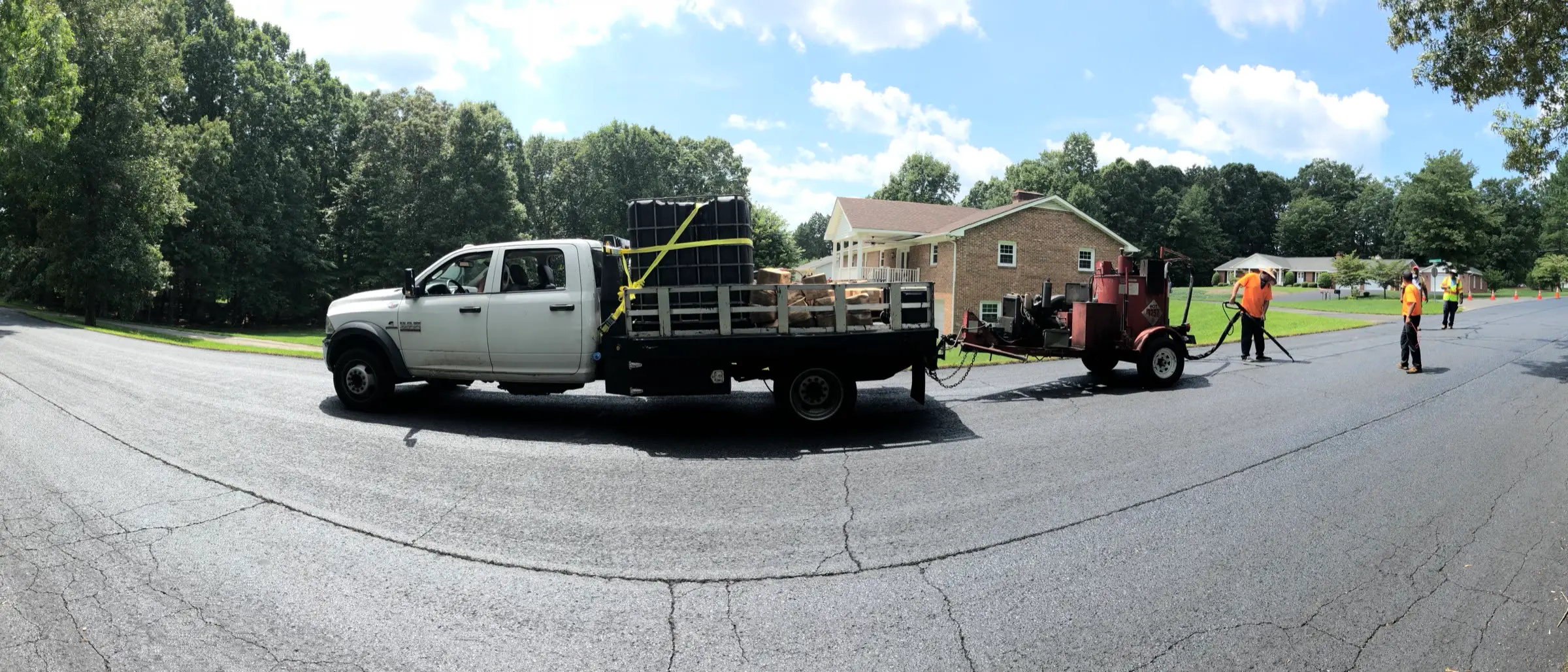
Two layered defenses against water and cracking. Hot-rubberized sealant locks moisture out of working joints; the bonded overlay glues new asphalt to the old so the two layers flex together — instead of cracking apart.
Cracks in asphalt are a water problem before they're a structural one. Surface cracks let water through the wearing course, into the binder course, and eventually under the slab. Once water gets under, freeze-thaw cycles do the rest — heaving, base failure, pothole formation. The first line of defense is keeping water at the surface.
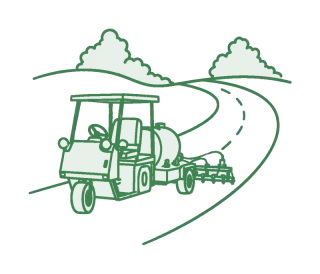
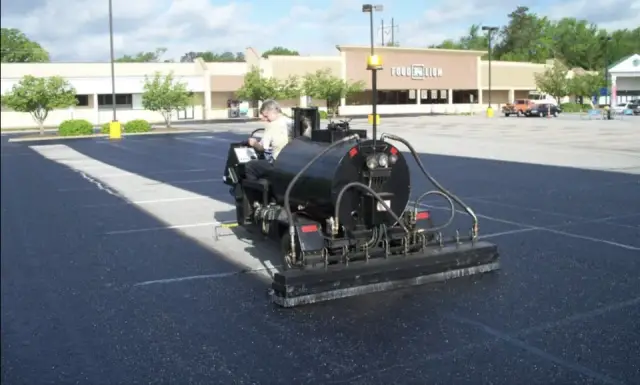
We handle that with hot-rubberized crack sealant — a polymer-modified asphalt-rubber compound applied at 380°F with a melter-applicator. It flows into the crack while liquid, then cools to a flexible-but-watertight seal that moves with the pavement instead of cracking with it. Working joints that would have separated again in a season hold for two to three years between treatments.
When sealing alone isn't enough — when the pavement is structurally sound but surface-cracked beyond what sealant can keep up with — we move to Fused-Bonded Overlay™. A standard mill-and-overlay lays a new lift of asphalt on top of the old one. Without an effective bond between the two layers, the new lift behaves like an independent slab — it cracks where the old slab cracks, in a pattern called reflection cracking. The field rule engineers use is about a year of clean surface for every inch of new asphalt laid over cracked pavement — so within a year or two, the same crack network you paved over is back.
The Fused-Bonded process replaces the liquid asphalt tack coat with a plant-based penetrating rejuvenator, sprayed onto the milled surface and given 30 to 60 minutes to soak in and dry back. It goes everywhere a tack coat would, and further — down into the cracks themselves, which by that point are packed with millings.
Then the new asphalt goes down hot, around 350°F. That heat drives the rejuvenating oils down into the old pavement — which on a typical Virginia lot is an old section two to three inches thick — and pulls oil up out of the new mat, and as the rollers pass, the two fuse into a single anchored section. The old asphalt underneath comes back softer and more flexible than it went in. Contractors who have watched it done are usually surprised by how quickly it happens, and by how complete it is: once the section cools, the two surfaces are close to impossible to separate.
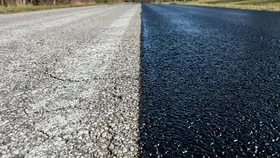
What that bond buys is time. It doesn't eliminate reflective cracking — the old slab underneath still moves — but it retards it. On our own overlays we've seen little or no reflective cracking in the first four to five years, against the year-per-inch the rule of thumb predicts. The bonded section itself serves 12 to 15 years before the next overlay is due.
Both begin with the same walk — we catalog the crack network before quoting either one. From there they diverge. Sealing treats working joints in a surface we're keeping. On a Fused-Bonded Overlay the surface is milled first, so the cracks are handled by the rejuvenator and the heat of the new mat, not by sealant.
We walk the lot and catalog the crack network: pattern type, average width, depth, and total linear feet. The inventory drives the spec — sealant volume and melter passes — and tells us whether sealing alone will hold.
Cracks get routed to a uniform reservoir geometry — typically 3/4" wide by 3/4" deep. The routed channel gets blown clean of debris and dust before sealant goes in.
Hot-rubberized sealant flows from the melter-applicator at 380°F. We band-and-overband each joint — filling the reservoir, then capping with a flush band 2-3" wide on the surface to anchor the seal.
Edge or profile milling takes the old surface down and re-establishes fall toward the drains; the millings go back to the plant to be recycled. We blow the loose material off and wire-brush anything stuck down — whatever sits on the surface blocks the rejuvenator. What's packed into the cracks stays where it is.
Same day, a plant-based penetrating rejuvenator goes down in place of a liquid asphalt tack coat — across the milled surface and into the millings packed in the cracks. It penetrates and dries back for 30 to 60 minutes. This is the step that decides whether the overlay fuses to the old surface or floats on it.
New asphalt goes down hot — around 350°F — at 1.5" minimum compacted, then gets rolled. The heat carries the rejuvenating oils down into the old pavement and draws oil up out of the new mat, and the two lock together as the section cools. Same-week return to full service for most lot configurations.
The numbers behind a crack sealing and Fused-Bonded Overlay™ job.
380°F
Application temp
Hot-rubberized sealant
1.5"
Crack width sealed
Max, after routing
4–5 yr
Reflective cracking held off
Observed on our own overlays
12–15 yr
Bonded section life
Before the next overlay is due
Sealant doesn't add structural life — it preserves it by keeping water out. The argument is what you avoid, not what you gain. Treat the figures below as ranges, not quotes.
| Approach | Typical cost | Service life | What it does |
|---|---|---|---|
| Crack sealing alone | $0.55 – $1.25 / linear ft | 2–3 years | Stops water at the surface. Doesn't address binder oxidation. |
| Fused-Bonded Overlay™ | $22.50 – $33.00 / SY | 12–15 years (cracks held off 4–5) | New lift fused to a rejuvenated surface — retards reflective cracking. |
| Conventional overlay | $20.25 – $30.00 / SY | 10–15 years (cracks return in 1–2) | Unbonded new lift. Old crack pattern telegraphs back. |
| Full reconstruction | $75.00 – $110.00 / SY | 15+ years | Remove + sub-base + new |
Sealing a working joint runs $0.55 to $1.25 per linear foot and holds it for two to three years. Letting that same joint take water until the section needs rebuilding costs $90 per square yard, in about eight years. That gap is what crack sealing pays for. But sealing only keeps water out of the joints, and the overlay only resets the surface — neither one stops the binder underneath from oxidizing, which is what decides how many of those cycles a lot gets.
Two lots in the same condition carrying the same traffic. The first gets a Fused-Bonded Overlay and nothing after it: the binder starts oxidizing the day it's laid, and the section lands at the bottom of that 12-to-15-year range — about 12 years — before the surface is spent. Left there, that is the ceiling. The second gets the same overlay, a rejuvenation pass within six months, and another every three to four years after that. Each pass resets the oxidation clock before the binder turns brittle, and on that cadence the model runs the same structure to roughly 36 years — about triple.
That 36 is projected from the maintenance cycle, not measured to term. It assumes the base and drainage underneath stay sound, and that the rejuvenation intervals are actually kept. Miss them and the curve falls back toward the untreated case.
It's the same discipline as the managed rejuvenation program described on the rejuvenation page — started from a freshly overlaid surface rather than an aging one, which is why the horizon here runs longer than the 25+ years that page cites for an existing lot.
Real pricing depends on crack density, lot accessibility, traffic class, and overlay thickness. The figures above are an order-of-magnitude comparison, not a quote.
Where reflection cracking from past overlays is the most common failure mode we get called in to fix.
Read moreWhere crack networks get sealed on a maintenance cycle — before water and freeze-thaw do the expensive damage.
Read moreWe walk the lot, catalog the cracks, and tell you whether sealing alone will hold or if overlay is the next move.
Read moreA free site walk, a one-sheet inventory of the joint network, and a recommendation — seal, overlay, or both. We tell you which.