




Asphalt rejuvenator
vs seal coat
Sealcoating is a surface film. Rejuvenation treats the aging itself. A sourced side-by-side — what each does, what the record shows, and what the law changed.
Put “asphalt rejuvenator vs seal coat” — or its sibling phrasing, “asphalt rejuvenation vs sealcoating” — into a search bar and you’re usually standing in the same spot: pavement that’s starting to look tired, two very different quotes on the table, and both treatments promising to leave the lot black and uniform by Friday. The confusion is understandable, because for the first week after application the two can look nearly identical. What they do is not similar at all: one of them coats the pavement, and the other one changes it.
Cards on the table before we compare anything: TriTechnologies applies asphalt rejuvenators, and we don’t sell sealcoating. Read everything below knowing that. We’ve also done something comparison pages usually don’t: cited our sources. The claims here lean on federal research reports, USGS publications, and state law — linked inline and collected at the end — so you can check every one of them without taking our word for anything.
What each treatment actually does
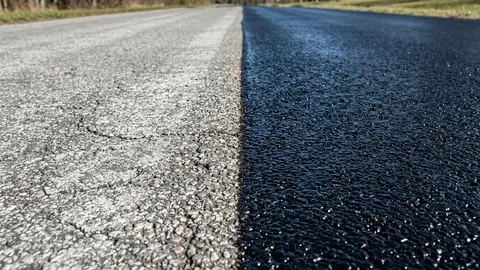
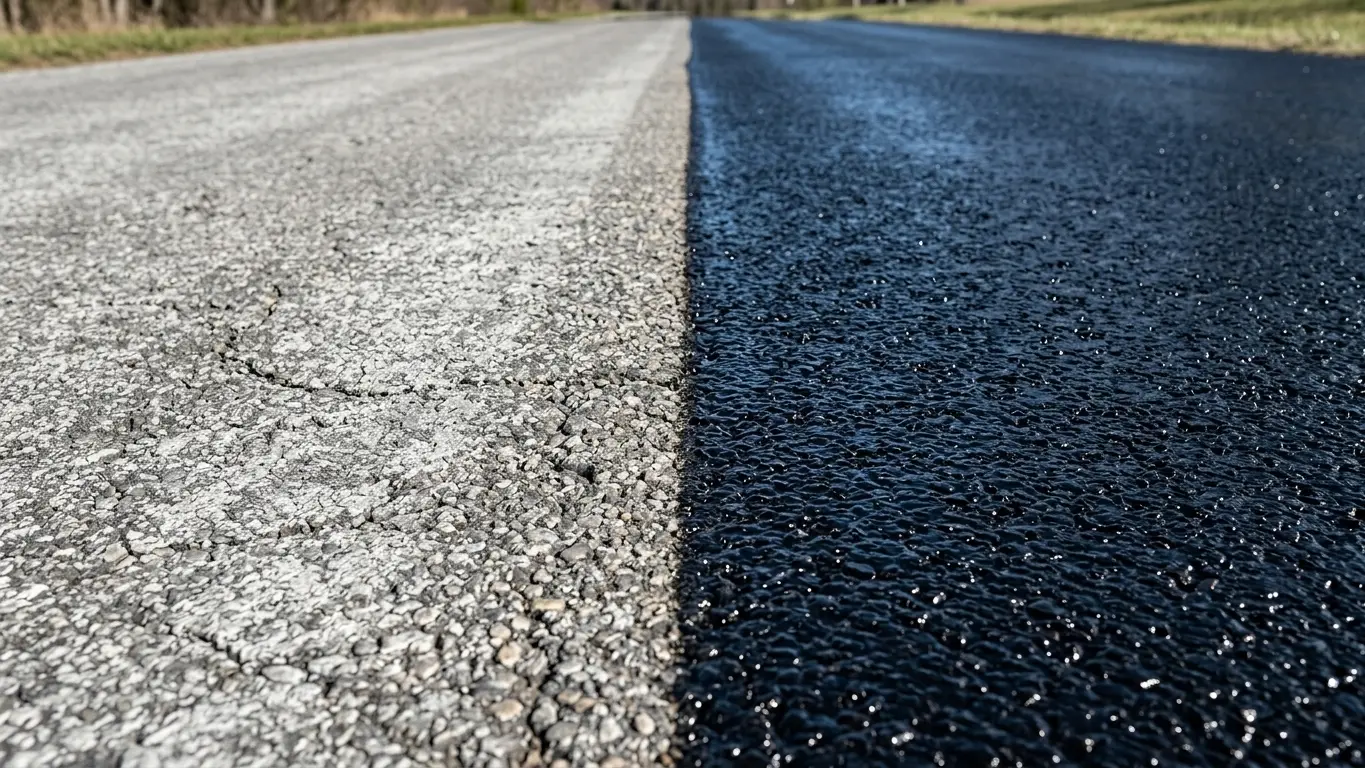
Sealcoating is a surface coat. An emulsion film is squeegeed or sprayed over the pavement, where it dries into a thin sacrificial layer. It delivers the uniform black finish most people picture when they imagine a freshly done lot, and while the film lasts it takes the UV, water, and tire wear that would otherwise land directly on the surface. What it doesn’t do is penetrate. The film sits on top, and the binder underneath it is the same age, the same stiffness, and the same chemistry it was the day before. The U.S. Geological Survey’s description is the plainest one in print: sealcoat is a layer that tire friction gradually abrades away, which is why applicators recommend reapplying it every one to five years.
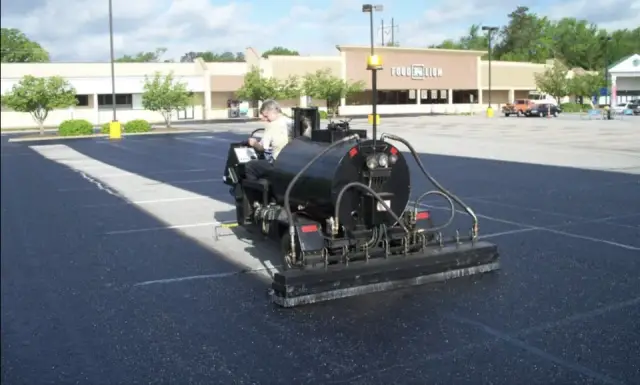
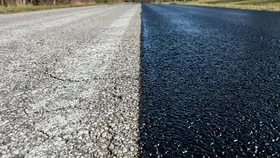
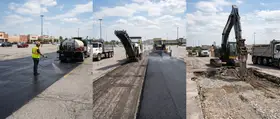
An asphalt rejuvenator is a chemical treatment of the aging itself. Asphalt ages from the top down: UV and oxygen burn off the binder’s light, oily fractions, leaving it stiffer and more brittle until the surface grays and cracks under load. A penetrating rejuvenator soaks into the wearing course, from three-eighths of an inch to a half inch, and works on the aged binder itself — reducing its stiffness and bringing flexibility back toward its original spec. The pavement flexes under traffic again instead of cracking. On a structurally sound lot, one pass reverses about four years of aging — and the surface is back in service the same day.
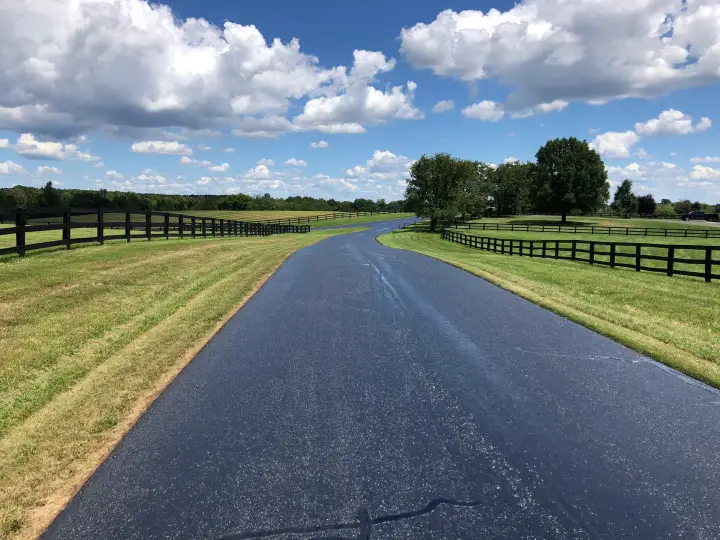
The line-up we apply is led by Revolution BLACK™, a 100% black plant-based rejuvenator from Greene Technologies Corporation — it cures black, which retires the old objection that rejuvenation restores the chemistry but not the look. Delta Mist®, the 100% clear plant-based option from Collaborative Aggregates, does the same job where an owner prefers a clear treatment. On any lot we treat, working cracks wider than about a quarter inch still get hot-rubberized sealant after the rejuvenator cures — the two jobs are complementary, in that order.
Sealcoating vs rejuvenation: the side-by-side
| Sealcoating | Asphalt rejuvenation | |
|---|---|---|
| What it does | Lays a sacrificial film on top of the surface — a uniform black appearance layer that shields the surface while it lasts. The aged binder underneath is unchanged. | Penetrates the wearing course and chemically restores the binder’s flexibility — treats the cause of the aging, not the look of it. |
| How long it lasts | Applicators recommend reapplying every one to five years; the film wears through first in drive lanes. Recoating is the design, not a defect. | Four years of added pavement life per application. On a four-year cycle, lots routinely stay in service 25+ years. |
| Cost pattern | Low per application, repeated indefinitely — a recurring appearance line item. Pricing varies too much by region, material, and coat count for honest generic numbers. | About $1.50–$3.00 per square yard per pass — which works out to $0.38–$0.66 per square yard per year on a managed 20-year program. |
| Where it fits | Appearance. A uniform black surface for a property where the look itself is the deliverable. No independent study shows it extends pavement life. | Oxidized-but-sound pavement — gray, dry, hairline cracking, base intact — where the goal is more service life per dollar. |
The sealcoating cells are deliberately number-free. Sealcoat pricing swings with region, material, lot size, and how many coats a bid actually includes — any specific figure we printed here would be somebody’s wrong number, and this page isn’t a sealcoating quote. The rejuvenation figures are the same planning ranges we publish everywhere else, modeled in depth in our commercial lifecycle cost analysis and its roadway companion. The comparison that matters in both models: cost per year of pavement life, not the size of the day-one invoice.
Is sealcoating worth it?
Here’s the most important sentence on this page, and it doesn’t come from us — it comes from the asphalt industry itself. In 2012, the National Asphalt Pavement Association’s director of engineering told the NIH journal Environmental Health Perspectives, speaking of pavement sealers: “We really don’t have any strong science on the benefits.”
That’s still the state of the evidence. We went looking for an independent study — any controlled comparison showing sealed parking lots or driveways outlast unsealed ones — and there isn’t one. The life-extension numbers that circulate in sealcoating proposals (“doubles pavement life,” the per-square-foot savings charts) trace back to the sealer industry’s own trade council, and they’re models built on the industry’s own assumptions, not field measurements.
So the honest answer splits in two. As an appearance purchase — a uniform black lot for a season or two — sealcoating does what it says, and if that’s genuinely what a property needs, it’s a legitimate line item. As a pavement-preservation strategy, it’s an unproven one: the film sits on top while the binder underneath keeps aging on exactly the same curve, and owners end up on a treadmill — seal, fade, re-seal — while the date the lot actually cracks and fails never moves.
That distinction isn’t theoretical for us. It’s why this company exists:
“I started in the pavement preservation industry with my father and brother. Initially, we used a seal coat to protect the surface of the pavement but quickly realized that the seal coat was not truly protecting the pavement. On the contrary, it was drying it out, chipping, and causing more cracking. We wanted to help preserve our customer’s asphalt investment — not repeat processes providing them short-term solutions.”
— Jeff Pokorny, Founder
One contractor’s field experience is an anecdote. What makes it worth printing is that the federal record points the same direction.
What the federal record shows
Sealcoating has been studied most closely where the stakes are highest — airfields — and three findings from that record are worth any owner’s time.
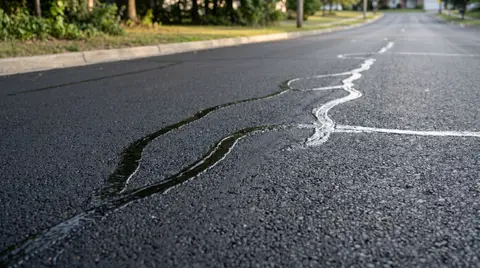
- The film cracks. The FAA’s own technical study of coal-tar seal coats found them exhibiting “scuffing, cracking, premature aging and reduced service life,” and the study team found cracking in the seal coats at every airport it visited — the full report is public, and we host a copy. A U.S. Army Corps of Engineers research report sixteen years later repeated the finding, calling cracking “a frequent occurrence with coal-tar sealers.”
- Repeat coats can harden the surface. That same Army Corps report relays Missouri DOT core data from pavements treated repeatedly with a coal-tar product: the surface binder tested harder than in untreated control sections, with ductility decreasing after the second application — excess coating building up and stiffening on the surface. Our founder watched that happen in the field decades ago; the Corps measured it.
- An emulsion seal is not a rejuvenator. In the 1976 three-base Air Force field study that federal rejuvenation guidance still leans on — summarized in the Asphalt Institute’s review, which we also host — three of the four rejuvenator products tested measurably softened the aged binder, while the asphalt-emulsion seal hardened it. An honest footnote, since we host the report: one of the four rejuvenators hardened it too. The record sorts these products by measured effect, not by the category printed on the label — which is exactly why you should ask what a treatment did in a test.
And the boundary of that record, stated plainly, because a comparison that only cuts one way isn’t honest: those findings document the sealer film and the pavement surface. Nobody on either side has run a controlled long-term study proving sealcoating shortens pavement life — just as nobody has run one proving it extends it. What the record supports is narrower and still decisive: the benefits are unproven, the film’s own failure modes are documented, and the cost recurs.
How long does sealcoating last?
Applicators themselves recommend reapplication every one to five years, and the film goes first where the traffic actually runs — drive lanes and tire paths gray out ahead of the stalls, which is why sealed lots develop a two-tone look between coats. Water and snow-plow blades shorten the clock further.
None of that is a flaw. A sacrificial layer is supposed to sacrifice itself, and every honest sealcoating contractor will tell you the plan is reapplication. The budgeting mistake is booking that recurring line item as life extension. It’s appearance maintenance, and it should be priced against appearance value — because no independent study prices it against the pavement’s failure timeline.
The law changed: coal-tar sealants are banned across our region
There’s one more thing a sealcoating comparison written in 2026 has to say, because it changed recently and many owners haven’t heard.
The classic sealcoat — the refined coal-tar emulsion that dominated East Coast sealcoating for decades — is now illegal to apply across the region we serve. Coal-tar pitch runs roughly half polycyclic aromatic hydrocarbons (PAHs) by weight, and two decades of USGS research found runoff particles from coal-tar-sealed lots carrying PAH concentrations about 65 times those from unsealed lots. The law followed the science:
- Washington, DC banned coal-tar pavement products in 2009 and expanded the ban in 2019 to any sealant over 0.1% PAH — actively enforced, with fines up to $2,500 per day.
- Maryland prohibited selling or applying high-PAH sealants statewide effective October 1, 2023, under the Safer Sealant Act.
- Virginia banned retail sale of pavement sealants over 1% PAH on July 1, 2024, and banned applying or using them on July 1, 2025, under § 62.1-196.1 of the Code of Virginia.
Two precise notes, because precision is the point of this page. First, none of this outlaws sealcoating itself: asphalt-emulsion sealers — the same chemistry family as the pavement, with on the order of a thousandth of the PAH content — remain fully legal, and they’re what the big-box stores have carried for the past decade. Second, the banned coal-tar class was the variant with the one genuinely documented functional advantage: petroleum resistance. Asphalt binder softens under fuel and oil; coal tar doesn’t, which is why FAA airfield construction standards include refined coal-tar seal coats for fuel-spillage areas. The emulsion sealers that remain legal in Virginia, Maryland, and DC don’t offer that resistance — which narrows the local case for sealcoating to what it always did best: the look.
Does asphalt rejuvenation work?
A fair question — it’s the first one we’d ask of any treatment claiming to reverse aging, and after a page spent asking sealcoating for its evidence, rejuvenation owes you the same. The evidence we point to is public:
- Accelerated testing. On NCAT’s test track — the pavement industry’s accelerated-loading proving ground — a bio-based rejuvenator in our line-up held a 40% reduction in the industry’s key aging measure across six years and 20 million axle loads.
- A long federal spec history. Rejuvenation as a technology class has been in use by the US Air Force and the FAA for over 40 years, and the FAA maintains specifications for pavement rejuvenation today — Engineering Brief 44B and Item P-632. Federal rejuvenation contracts are written around measured results — recovered binder from the treated pavement has to test measurably softer, with retreatment at the contractor’s expense until it does.
- A warranty with a number in it. Rejuvenation work we perform is backed by our 4-Year Performance Warranty — in writing, at no additional cost.
And the honest boundary, because a comparison page that only lists wins isn’t one: rejuvenation restores binder chemistry. It does not fix structure. Alligator cracking through the full depth, deep rutting, base failure — that pavement needs reconstruction, and anyone spraying rejuvenator or sealcoat over a failed base is taking your money for a problem neither treatment can touch. Our asphalt rejuvenation service page walks through the full process, including the assessment step where we tell you which category your lot is in.
How long does asphalt rejuvenation last?
Four years of restored pavement life per application — that’s the figure our written warranty is built around, and the treatment’s expected service life is something we report separately from the warranty because real pavement life depends on traffic, climate, and original construction.
The number that matters more is what the cycle does. Most of our long-term clients treat on a four-year cadence, and on that cadence a lot routinely stays in service for 25+ years before reconstruction becomes necessary — versus the 15–18 years of a pave-and-forget cycle. Per square yard per year, a managed rejuvenation program runs $0.38–$0.66 against $2.03–$3.00 for a mill-and-overlay path. That spread is where the headline comes from: a preservation program built on rejuvenation can cut a pavement maintenance budget by up to 80% — without tearing out a single inch.
Parking lots, property managers, and the commercial sealcoating question
The reader we hear from most isn’t a homeowner. It’s a property manager or facilities lead pricing “commercial sealcoating” or “parking lot sealcoating” across a portfolio — usually because sealcoating is the maintenance line item they inherited. For that reader, the comparison stops being about which product and becomes about what the budget line actually buys.
A commercial sealcoating program is an appearance budget: a recurring spend that keeps the blacktop looking uniform and has never been shown to move the date the pavement fails. A preservation program is a lifecycle budget: a recurring spend aimed at moving the capital event — overlay or reconstruction — years further out. If your asset plan is judged on curb appeal alone, sealcoating serves it, and nothing more can be claimed for it. If it’s judged on cost per year of service and the timing of the next capital project, the same dollars work harder in the binder.
In practice, what commercial pavement needs is rarely one product anyway — it’s a sequence: rejuvenate the field, seal the working cracks after the treatment cures, restripe while the surface is fresh. That’s the program laid out on our asphalt maintenance page, and it’s how we run lots and community road networks across Virginia, Maryland, and DC from Fredericksburg. The roadway version of the math — priced per centerline mile for HOA boards and public-works buyers — is in the roadway preservation analysis.
The straight recommendation
Every comparison page on the internet ends with “it depends,” so here’s how to make it stop depending: put the actual lot in front of someone who will tell you the truth about it.
We do that for free — an on-site assessment, a one-sheet report, and a straight recommendation. If what a property genuinely needs is a season of uniform black and nothing more, a sealcoat will buy exactly that, and we’ll say so — we don’t sell sealcoating, so we have nothing to gain either way. What we won’t do is call it pavement preservation, because the evidence doesn’t. If the lot has gone gray and the binder is what’s failing, we’ll show you the rejuvenation math and put the recommendation — and the warranty — in writing. Request the assessment, and bring your toughest questions. This page was the easy version.
Sources & further reading
Every load-bearing claim above traces to one of the documents below. Two are public-domain federal reports we host ourselves because they’re worth reading in full; the rest link to official sources.
- DOT/FAA PM-87-9 — Criteria for Coal Tar Seal Coats on Airport Pavements (1987). The FAA’s technical study of coal-tar seal coat performance: formulations, field distress, and the cracking record. Hosted PDF
- Boyer, Asphalt Rejuvenators: Fact or Fable (Asphalt Institute, 2000). The chemistry and federal test history of penetrating asphalt rejuvenators, including the 1976 three-base Air Force field study. Hosted PDF
- Shoenberger, Rejuvenators, Rejuvenator/Sealers, and Seal Coats for Airfield Pavements (U.S. Army Corps of Engineers, ERDC, 2003). Field and laboratory evaluations across all three product classes, including the coal-tar cracking record and the Missouri DOT repeated-application data. Official copy at DTIC
- USGS Fact Sheet 2016-3017 — Coal-Tar-Based Pavement Sealcoat (2016). What sealcoat is, how it wears, and the PAH findings that drove the regional bans. pubs.usgs.gov
- Environmental Health Perspectives, “Studies Raise Questions About Pavement Sealers” (2012). The NIH-journal report carrying the National Asphalt Pavement Association’s assessment of sealer science. pmc.ncbi.nlm.nih.gov
- FAA AC 150/5370-10H, Items P-630/P-631. The federal airfield construction specs for refined coal-tar emulsion seal coats on fuel-spillage areas. faa.gov
- Code of Virginia § 62.1-196.1. Virginia’s high-PAH pavement sealant prohibition — retail sale from July 1, 2024; application from July 1, 2025. law.lis.virginia.gov
- Maryland Safer Sealant Act of 2022 (SB 372, Ch. 710). Maryland’s statewide high-PAH sealant prohibition, effective October 1, 2023. mgaleg.maryland.gov
- DC coal-tar and high-PAH sealant ban. In force since 2009, expanded in 2019. doee.dc.gov
Short answers to the follow-up questions.
- Is sealcoating worth it?
- For appearance, sometimes. For pavement life, no one has proven it: there is no independent study showing sealed pavement outlasts unsealed pavement, and even the asphalt industry's own engineers say the science on sealer benefits is missing. A sealcoat reliably delivers one thing — a uniform black surface for a season or two. If the goal is longer pavement life, the money belongs in the binder, which is the part of the asphalt that is actually aging.
- Is sealcoating necessary?
- No — nothing about a sealcoat is structural, and a lot can serve a full life without ever being sealed. The maintenance that actually moves the failure date is keeping water out of the base with crack sealing and keeping the binder flexible, which is what rejuvenation does. Sealcoating is an elective appearance layer, and its costs recur by design.
- How long does sealcoating last?
- Applicators themselves recommend reapplying every one to five years, and the film wears through first in drive lanes and tire paths — federal researchers describe sealcoat as a sacrificial layer that tire friction gradually abrades away. The plan is always reapplication. The budgeting mistake is booking that recurring line item as pavement life extension, because no independent study shows that it is one.
- Does asphalt rejuvenation work?
- On structurally sound, oxidized pavement, yes — and the evidence is public. On NCAT's accelerated test track, a bio-based rejuvenator in our line-up held a 40% reduction in the industry's key aging measure across six years and 20 million axle loads, and the technology class has been in use by the US Air Force and the FAA for over 40 years. What it doesn't do is fix a failed base — that's reconstruction, and we'll tell you if that's what your lot actually needs.
- How long does asphalt rejuvenation last?
- A single application restores about four years of pavement life — the figure our written 4-Year Performance Warranty is built around. Applied on a managed four-year cycle, rejuvenation routinely keeps pavement in service for 25 or more years before reconstruction becomes necessary.
- Why is sealing your blacktop driveway pointless?
- That phrasing comes from a syndicated home-improvement column, and it's half right. A sealcoat can't help pavement that has already gone gray — the film resets the color for a season while the binder underneath keeps stiffening on the same curve, which is why so many owners feel sealing "did nothing." The honest correction: sealing isn't pointless if a uniform black surface is genuinely what you're buying. It's unproven as a life-extension strategy — no independent study shows it is one. Once the binder is what's failing, the useful treatment is the one that penetrates and restores it: rejuvenation.
- What is the best asphalt resurfacer?
- "Resurfacer" usually refers to thin patching or overlay products that replace a worn surface with new material — a different tool from both a sealcoat and a rejuvenator. If the surface is genuinely spent, the honest fix is a real overlay. If the asphalt is aged but intact, a rejuvenator addresses the actual problem — depleted binder — without adding material. The best product is the one that matches your pavement's failure mode, and pinning that down is what an on-site assessment is for.
More from the Insights desk.
- Roadway economics
Roadway preservation costs: rejuvenation vs. micro-surfacing vs. mill-and-resurface, per centerline mile
What it actually costs to keep a 24-foot roadway in service for 24 years — three preservation strategies compared on annualized cost per centerline mile, and why the lightest treatment on the most frequent cycle wins the budget.
Read the piece - Lifecycle economics
Pavement lifecycle cost analysis: rejuvenation vs. mill-and-overlay vs. full reconstruction
A 20-year, cost-per-square-yard breakdown of the three pavement paths most facility managers face — and why the cheapest option on day one is rarely the cheapest one by year ten.
Read the piece
The page version is the abstract.
Your lot is the specific.
A free site walk, a one-sheet report, and a straight recommendation — rejuvenation, sealing, overlay, reconstruction, or "not yet." We tell you which, even when the honest answer costs us the sale.